Carried Through Compassionate Care: Brittany’s ECMO Story
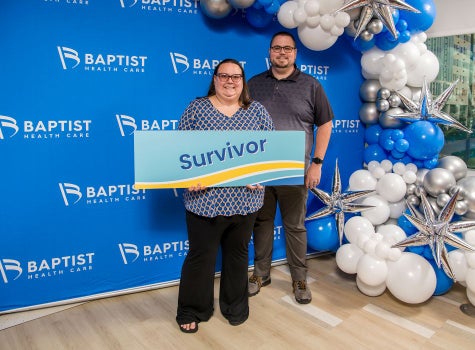
What began as a routine illness quickly became life-threatening for Brittany Herndon. After testing positive for COVID‑19 at an urgent care facility in her hometown of Brewton, Alabama, Brittany was transferred to the local hospital, where her condition rapidly worsened. She was placed on a ventilator, but despite aggressive treatment, her lungs did not improve.
As her condition continued to decline, the decision was made to transfer Brittany to a Pensacola hospital for a higher level of critical care. She was admitted to the ICU and placed on a ventilator, where she remained for approximately a week and a half. When her lungs still showed no signs of recovery, Brittany was transferred again — this time to Baptist Hospital — for advanced support and consideration of extracorporeal membrane oxygenation, or ECMO.
Doctors continued ventilator treatment while closely monitoring her progress, but it soon became clear that her lungs were not improving. The care team spoke with Brittany’s mother about the possibility of placing her on extracorporeal membrane oxygenation, or ECMO — a decision that would play a critical role in saving her life.
Brittany was placed in a medically induced coma and does not consciously remember the challenges of being on ECMO. In fact, she was unaware she had been placed on the life‑support system until she woke up near the end of her treatment. Like many ECMO survivors, the reality of everything her body endured did not fully register right away. For Brittany, it felt like lost time.
Looking back, Brittany reflects on her experience with gratitude, not for what she remembers, but for the care and compassion she received while she could not speak or advocate for herself.
After ECMO, Brittany’s recovery did not require dramatic changes to her daily life. She was able to return to her normal routine, resuming the lifestyle she had before her hospitalization — something she now appreciates on a deeper level.
Throughout her ECMO journey, Brittany was surrounded by an extraordinary network of support. Her mother and brother stood by her side, as did her now husband, whose devotion remained constant. She was also uplifted by her in‑laws, both of her grandmothers, her aunts and several of her husband’s co-workers, all of whom offered steady encouragement and care during an uncertain time.
Brittany also credits the nurses who cared for her from the very beginning through the end of her treatment. Their compassion, vigilance and dedication ensured she was never alone, even when she was unable to realize it.
Today, Brittany’s story is one of quiet resilience — a reminder that even in moments we cannot remember, expert care, unwavering support and compassion can change the course of a life.